
The dot on the horizon of this research was to enable the monitoring of a large group of animals for a long period of time using either tracking data and/or video footage with minimum input from people and having minimal invasive impact on the animals under study. Locomotion of dairy cattle was selected as use-case; lameness or abnormal behaviour due to lameness have a negative impact on animal health and welfare, and production. Monitoring lameness is often done through visual assessment of abnormal locomotion, but visual assessment is subjective and time consuming. Also, very mild cases of lameness and subtle changes in locomotion are difficult to see. The objective of this study was two-fold: (1) develop an infrastructure at our research facility Dairy Campus (www.dairycampus.nl) that allows continuous collection, storage, and synchronisation of high-quality raw sensor data, (2) develop tools to retrieve relevant information for the continuous monitoring of (behaviour related to) locomotion from these raw sensor data.
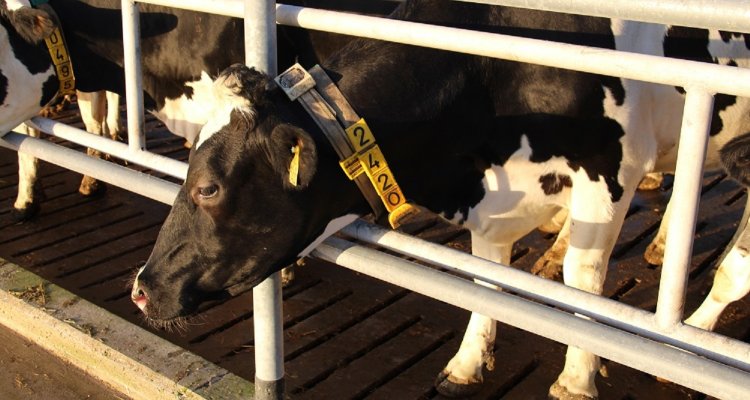
Technology used in this research included an ultrawideband tracking device and cameras. The tracking device (Tracklab, Noldus Information Technology) was installed such that raw XY-position data of 112 animals were recorded 24/7. Cameras were installed at three different locations at Dairy Campus: (1) one research unit housing 16 cows was equipped with eight Axis cameras (Noldus Information Technology) offering bird-view video footage (from 5am to 6pm), (2) two Hikvision IP cameras were installed in the exit of the milking parlour, allowing the collection of side-view video footage of the same 112 cows that were fitted with a tracking device when walking back from the milking parlour to the barn twice daily, for three hours per milk session, and (3) two Reolink IP cameras in the milking parlour itself, allowing the collection of video-footage of all ~450 dairy cows milked in the rotary, while standing on the rotary platform twice a day.
A data architecture was developed allowing raw sensor data collection and data quality control pipelines at different locations and at different levels. For example, to ensure proper functioning of hardware (e.g., ultrawideband anchors and cameras), a ping was requested every minute from every device. If no pings were generated, an email was sent to the data engineer indicating which hardware was not functioning. Another level of data quality control involved the control of tracking tags. A digital tool was developed to record which tag was fitted to which cow, that showed the battery status of the tag, and that checked whether cows went back to the research unit they were supposed to be in when returning from milking. Another level of data quality control involved the data collection and storage pipelines. Tools for monitoring and controlling data quality are detailed in. Tools were developed that helped going from (1) raw tracking data to one XY-position per cow per second, and from that to 24h activity bouts per cow with a tracking device, (2) from raw video footage to gait features that can be used for cow individual locomotion monitoring over time, (3) raw video footage to the tracking of 3D key points of individual cows housed in a group, allowing the assessment of behaviour (e.g., time to get up or lie down, (4) from raw video footage to classification of DD status, and (5) from using the processed raw position data to walking trajectories essential for understanding transmission.