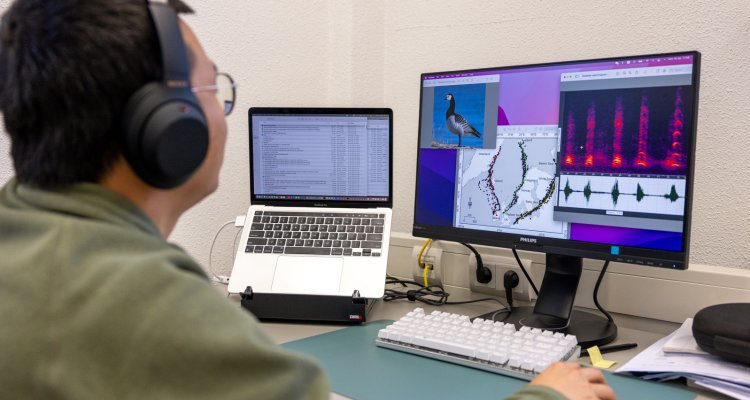
Individual recognition is crucial in dynamic social environments, and many group-living animals have evolved distinct signals for this purpose. Researchers have developed a system to automatically record, detect, and classify individual vocalisations to construct social networks, and they successfully applied it to study zebra finches in their natural habitat.
Using machine learning, audio streams were transformed into meaningful data about individual birds' locations and interactions. This innovative method bypasses the need for traditional tracking techniques, offering an efficient alternative for monitoring vocally active species. By analysing the vocalisations of zebra finches, researchers gained a unique understanding of natural behaviour and social structures. These developed methods can now be applied to study the social dynamics of many other species in their natural habitats.
Scientific output
Loning, H., Verkade, L., Griffith, S. C., & Naguib, M. (2023). The social role of song in wild zebra finches. Current Biology, 33, 372–380. https://doi.org/10.1016/j.cub.2022.11.047
Presentations
Loning, H., ter Avest, E., Griffith, S. C., & Naguib, M. (2024). The social organisation and song behaviour of zebra finches in the wild. Annual meeting of the Ethological Society Germany. Münster, Germany, 23rd February. (presentation)
Loning, H., ter Avest, E., Griffith, S. C., & Naguib, M. (2024). The social organisation and song behaviour of zebra finches in the wild. Invited talk at UZH Zürich, Switzerland, 17th April. (presentation)